vendredi 6 février 2015

Sidi Bel Abbes (Algeria)


City of Sidi Bel Abbes


Sidi Bel Abbes wants to show increasing its tourist potential. This city which is nicknamed "The little Paris" has something spellbound. It remains deeply marked by its urbanism that has suggested to Napoleon III during his visit (May 1865): "It's a lil Paris! The styles of the second half of the nineteenth century there are noticeable. This is an open-air museum. There are large shady avenues lined with beautiful buildings including castles, Châtelets, administrative buildings and mansions beautifully made. Sidi Bel Abbes is an airy city where the walk takes us from one discovery. Among the recommended monuments include the office of the Town Hall, built in 1875, with its imposing facade, the old church, the gatehouse Lomet to the more sober lines, which currently houses the School of Fine Arts, the Napoleon Castle Square November 1st (ex-Carnot) which is the center of the city and is flanked by the theater, on one hand, and the court, on the other hand, with its center in a nice booth that decorates the 'reigning atmosphere. There was also the dome, built in 1954 to serve the wholesale market for fruits and vegetables, and public garden containing rare species introduced from layout and a set of equipment. A first artificial beach, nationally, will be located at the lake Sidi M'hamed Benali, located in the town of Ain TLID, 3 km from the town of Sidi Bel Abbes. This artificial beach will last a lake with an area of 7700 square meters and a depth of between 80 cm and 1 meter. The project is supported by the local management of hydraulics, which will undertake all the amenities and will transfer the lake water to the artificial beach, processing and installation of adequate equipment to create mini waves . The creation of this artificial beach is part of a project to build a leisure center on this natural site, which drains, especially during weekends and holidays, hundreds of visitors, looking for a place to rest and tranquility. Located three kilometers from Sidi Bel Abbes, this lake, nestled at the foot of Tessala Mountains is a tourist site greatly appreciated for its beauty and its micro-climate that prevails. Many tourists who expressed their amazement at the stunning scenery and mild climate. Space of discovery and knowledge, Lake Sidi M'hamed Benali is also, for lovers of photography, a photographic base, because it is a true rich deposit in migratory birds and waterfowl such as mallard , ducks and moorhens, the flamingo, the greylag goose. Fishing trips are organized between friends, just to cut with the daily fast-paced major cities. Here, the visitor is in the arms of nature. A sort of homecoming, authenticity and beauty of the landscape. You do not see the time passing. Young and old alike can jog to fresh air and keep fit. For those who want to drink spirituality and ancient wisdom, there many brotherhoods such as El Aissaouia, Eddarkaouya El Ulwya and Tidjania located in Ras El Ma. Many delegations come to stop. Religious tourism is a major trend that transforms the global travel industry. An estimated 330 million the number of passengers who fly every year to sacred sites and places of pilgrimage. Traditionally reserved for devout practitioners leading a strict religious approach this market now affects people eager for new experiences and motivated by different aspirations. Like religion, religious tourism is becoming more individualized, is a reflection of a more modern religiosity and a more contemporary spirituality. Thus, Sidi Bel Abbes can surf three products: urban tourism, ecological tourism, spiritual tourism. Le P'tit Paris thinks big!

Largest city in the west of the country, 80 km south-west of Oran, at an average altitude of 470 m on the Mekerra the center of a vast plain between the Jebel Tessalah north and the mountains Dhaia to south, its area is around 8300km² and the number of inhabitants was 529,704 in 1998.


 originally Sidi Bel Abbes was built in a checkerboard pierced rectangular central four-door watching the cardinal points. Doors and demolished walls allowed the extension of the city where the suburbs widened steadily.


 The main arteries connecting the old doors, the street that extends Tebessi Larbi Mohamed V Avenue, the Republic Boulevard and the boulevard Emir Abdelkader former General Rollet cross at the right angle at the intersection of four clocks, geometric center of the city. The entertainment center is the place of the former Carnot 1 November 1954, which extends between the court and the regional theater, nationally renowned, Sidi Bel Abbes. The cultural center Sheikh Benghazi equipped with computer equipment allows the youth of the city to be connected with its 'cyberspace', in addition to books and other reading magazines.


 Nearly four clocks on the Avenue Larbi Tebessi the Officers' Mess (converted to complex) surrounded by cool shades, remains an attraction of the city because of its beautiful garden. The Republic Square, along the avenue Mohamed V we arrive at Martyrs Square dominated right cupola, art architecture, home to a planetarium and various shops, further north the intersection of road Oran, west of Avenue Lieutenant Khelladi leads to the district of Sidi Bel Abbes.

 The cemetery and the marabout Sidi Bel Abbes, holy character of the line of descendants of the prophet and son of Sidi El Bouzidi and who lived in the eighteenth century and left the entire region a revered memory. North Tessalah going towards the university area, home of the faculties of science and law. 
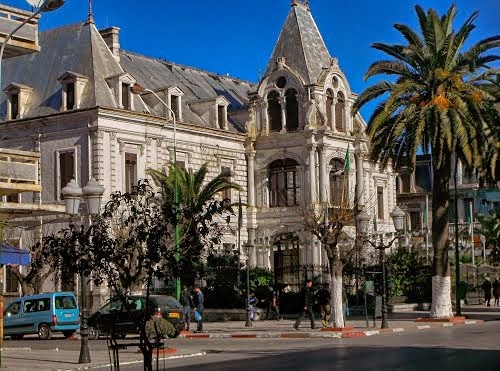


 Place Carnot


 Beni Tala Hotel

School of Fine Arts


The current Sidi Bel Abbes has become a major center radiating socioeconomic over the entire region, firstly by its rich industrial fabric of an industrial area located southeast of the city, there are two large industrial complexes (electronic and mechanical) and the small and medium enterprise (plastics, building materials, ...). The city of Sidi Bel Abbes continues to grow and is among the cities that passed its urban plan.


 The University of Djillali Liabes whose District Office is located on the former agricultural school occupies a special place in the life of the city, different scientific and cultural events are controlled by the university added to that the different interactive projects including academics associated (eco-development projects, statistics, studies, etc ...).


public garden

The Avenue Macta


 The city of Sidi Bel Abbes also has a park with rare species of trees, vegetable garden once, became the oxygen area of the city where young and old are exercised jogging, garden recently with wild animals. Adjoining the park, the outdoor theater, a relaxation area designed for cultural and musical entertainment for hot summer nights. In Macon area, north of the city, the garden and the forest house, reserve archive for history enthusiasts. Further north on the way to the foot of the Ain Trid Tessalah Mountains, Lake If M'hamed Benali, large water reservoir surrounded by a beautiful pine forest, a must for walkers spring and summer.


 Lake Sidi M'hamed Ben Ali


In reality it is not a pond, a water reservoir intended to contain and to initially control flooding of Mekerra who was Sidi Bel Abbes often swamp the taste of settlers who made their Eldorado. Sidi M'hammed - Ben Ali is powered recovering runoff from Mount Tessalah and canal diverting the overflow flood of Mekerra. This is simply a pond with stagnant water, most of the year and which is connected to the spillway dam Sarno, famous in the circle of the architecture for the originality of its daisy shaped design to eight petals. If nothing is done by Mother Nature, such waters reserves (this also applies to certain types of lakes) are doomed, and even condemned to be gradually filled by alluvial deposits that accumulate as on their funds. Excessive evaporation doing the rest, only frequent water receiving may, without a doubt, make the "lake" optimal viability and thus perpetuate the now in a natural setting, at the option of human genius. At birth it was decided to let the water take it easy to blend with nature itself - indeed welcoming. This allowed the stabilization of a particular ecosystem in the region of Sidi Bel Abbes, ecosystem formed by an association of living beings (biota) and its environment. It is a dynamic complex of micro-organisms, plants, fish, plankton that eventually settle and give life to a whole unsuspected world, though vulnerable, constantly in critical danger and easy to destabilize. It is this dynamic complex - which should have been protected - which has done to the ecosystem an unprecedented upheaval, engaging the lake in an accelerated agony and we absolutely do not accept fate, too easy parade to clear itself. Where were the environmentalists and their multiple associations, who are worried today unjustly for harvesting some carob trees on the route of the tramway, with strength and hype? Where was the university with its patented experts? These circles were alerted use their weight and their scientific arguments to oppose any work on and around the lake, knowing with certainty that we were going to a disaster foretold, while we, neophytes, had everything to deter policymakers braving the regulations since they were, at that time, no registered for the operating budget. After the catastrophe predicted with certainty and enjoying the executive change, some associations boasting ecologists, unknown to the larger number and a bag arisen conjurer, have suddenly awakened to deplore the visual degradation of the lake,, well, oh too late in adopting a new approach in the zeitgeist, gesturing for ulterior motives, reminding them how dedicated this adage: "other times, other morals" of course.


lundi 2 février 2015

Algeria,The city of Algiers


The city of Algiers


The city of Algiers is the political capital, administrative and economic of Algeria, is located on the Mediterranean. Algiers is nicknamed El Bahdja or as Alger La Blanche because of the local architecture and colonial buildings sparkling white. In Roman times the city was called Iscosium. The population of the city of Algiers is estimated at about 1.5 million inhabitants (Alger Centre) on the agglomeration of Greater Algiers can be estimated at 4,000,000 inhabitants. Algiers is a great Mediterranean port and the main port of the country including a traffic 18,000 000 t of goods in 2010. The main industries of Algiers are metallurgy, oil refining, petrochemical and food . The main export products are cereals, oil, vegetables, citrus fruit, wine, phosphates and iron. There are a lot of interesting things to see and do in Algiers, visitors can learn a lot about the Algiers history by visiting the many museums scattered throughout the city. In addition to the museums, Algiers has a set of monuments and historic buildings legacy of a long history as the Casbah, Notre Dame d'Afrique, the Great Mosque ...


The typical French colonial buildings mingle with Algerian constructions with perfect harmony painted a gleaming white giving Algiers sea air and a unique purity.

The city of Algiers is a maze of alleys and dead ends, stairs, many and varied (wide, narrow, high) are very convenient to travel around this architecture waterfalls.

Algiers is mostly a city of young people, students who go out and live!

Life is hectic in Algiers, economic, scientific, social and cultural activity is very rich.

Cultural festivals, sporting events and other music concerts are always joyfully celebrated.


The Places to Visit in Algiers


Algiers is built on an exceptional site in front of the mediterranean sea. The modern part of the city is built on the plateau at the sea, the old part, the ancient city of deys is built at the steep hill behind the modern town and is crowned by the Kasbah 122 meters above the Wed.


The Basilica of Our Lady of Africa in Algiers:


Our Lady of Africa, formerly known as "Lady of Africa" or "Lella Miriam" by the Algiers is located in the district of Z'Ghara, it rises to 124 meters above sea level and dominates thereby neighborhoods west of Algiers. The basilica was completed in 1872 after 14 years of work, it is the work of French architect Jean Eugène Fromageau. The exterior is built in a Byzantine style, when inside she is inspired by Moorish architecture.


Our Lady of Africa is mostly a shrine to Mary, mother of Jesus. Behind the altar in the apse wall of a maxim inscribed in French, Arabic and Berber says: "Our Lady of Africa pray for us and for Muslims. "Over time the building is constantly degraded in November 2006, the EU, the French Government and the city of Algiers agreed to share the cost of restoring the building. The work was entrusted to a French company that partners with Algerian companies. Young end of the Casbah are trained for careers in stone carving and masonry on ancient heritage. The restoration works were ended in summer 2010. The Basilica is open to visitors from 11am to 12.30pm and from 15h to 17h30. Daily Mass is 18h


The Garden of Algiers:


Le Jardin d'Essai, situated in the Hamma district is a botanical gem of over 3000 plant species providing a breath of fresh air in the center of Algiers. The creation of the Jardin d'Essai was decided in 1832 by the French General Avisard. At its inception the park had an area of 5 hectares. Since the Garden did not cease to grow and now covers an area of 32 hectares. Originally the garden was especially created in the hope of improving crop yields in agriculture. The west side of the garden is occupied by the French garden. In the center is the large driveway of plane trees. To the east is the old garden. What attracts the eye of the visitor is the contrast between the French garden well cut and arranged in tiers and the rest of the garden or tree trunks to form tortuous and tropical flora plunge you into an exotic plant world unknown in the region globe.


The Algiers Test Garden is deemed to be one of the most beautiful gardens in the world. Since November 2011, the Garden is now served by the Algiers metro station. The garden tour is a must do in Algiers.


Bab el oued:


Bab el Oued is a popular area which extends from the Casbah beyond "the gate of the river", famous for its place "the three clocks" and his "Triolet market," it is also a district workshops and factories.

La Casbah:

The Casbah (which means "Citadel") is the ancient citadel of Algiers, we gradually Appella the Casbah wide area around the citadel. The Casbah of Algiers was founded on the ruins of the ancient city founded by the Romans, Icosium. Built on a hill, down to the sea and divided into two: the upper and lower Casbah Casbah. It contains buildings and mosques of the 17th century; Ketchaoua the mosque (built in 1794 by the Dey Baba Hassan) flanked by two minarets, mosque el Djedid (built in 1660, when the Turkish regency) with its large ovoid dome and four cupolas, the mosque El Kebir (the oldest mosques, it was built by the Almoravid ruler Yusuf ibn Tashfin and later rebuilt in 1794), the mosque Ali Betchnin (Rais, 1623), Dar Aziza palace Jenina. The Citadel the top of its 125 meters dominates the whole area of the Kasbah. The neighborhood of the Casbah was classified in 1992 on the list of UNESCO World Heritage.


Against the massif of Bouzaréah, and near the rich Mitidja plain, the Algiers Casbah was built on a steep slope (118 m elevation) facing the harbor bay and the Mediterranean. In the Casbah, the principles of the Turkish military architecture are combined with Moorish architectural traditions and wider Arab Mediterranean. The white houses with flat roofs topped terraces, shake and intertwine throughout the slope. Great monuments, often decorated with carved woodwork and pottery, gardens and fountains punctuate the landscape and contribute to its intensity: the Great Mosque (XI XIV c.), Mosque Sidi Abd al-Rahman (XVIII century.) the mosque Ketchaoua (XVIII XIX c.) and the Dar al-Aziza Bent Bey (sixteenth palace c.) are among them. "The Casbah is an outstanding example of a type of building or architectural ensemble which illustrates a significant stage in history" (IV). It also offers "an outstanding example of a traditional human settlement representative of a culture and become vulnerable under the impact of irreversible change" (V).

Great Post:


La Grande Poste Algiers is a magnificent and imposing building not to be missed during your visit to Algiers. Built in 1910 on the site of an old Turkish fort by French architects and Voinot Toudoire, neo-Moorish style building is a symbol of oriental architectural style of the time required by the Governor General in Jonnart reconciliation worries between settlers and Algerians.


The interior is beautiful and of great refinement is inspired by the Hispano-Moorish style of Andalusia. The external façade with its typical Moorish domes, minarets, marble staircase and large wooden doors. The mailboxes of the time that are near the entrance are also worth a look.


Makam El Shaheed (Martyr Memorial):


The Martyr Memorial is a memorial commemorating the war in Algeria for independence. The monument was inaugurated in 1982 for the 20th anniversary of the independence of Algeria. The monument is located on the heights of Algiers, in the municipality of El Madania near Riadh El Feth mall. It overlooks the neighborhood Hamma (Municipality of Belouizdad) and the Test Garden. The monument was erected on the site of a former military fort. The monument was entrusted to the Canadian company Lavalin. Several Algerian artists participate as Yelles Bachir Skander Abdelhamid and calligrapher.


The monument with a height of 92 meters consists of three palm leaves that meet at mid-height of an Islamic-style turret with a diameter of 10 meters and a height of 7.6 meters and topped a dome of 6 meters. The edge of each palm leaf stands a statue of a soldier, each representing a stage in the struggle for the independence of Algeria. It rests on an esplanade or burning an eternal flame. Below the monument is such a crypt, an amphitheater and museum Mujahid Nine months (November 15, 1981 to July 5, 1982) were necessary to build this architectural work.


History of Algiers


French bombardment during the capture of Algiers in 1830


Legend has it that there very long 20 companions of the hero Hercules sailed in the Bay of Algiers and decided to settle. The Phoenicians used it as a relay between Algiers Carthage in the East and the columns of Hercules to the west. For many centuries Algiers was a disputed practice anchor the great powers - the Romans took in 146 BC and named Icosium the Vandals in the 5th century AD, Byzantines in the 6th century took over and developed a small Christian community, and in 650 became Alger now under Arab control. Until the 10th century the town remained insignificant until the leader of the Berber Bologhin ibn Ziri took control of the region in 970 years after the Fatimids moved their capital in Mahdia (Tunisia) to Cairo, Ibn Ziri named El-Djezaïr city, as it is still called today.

The sultans of Tlemcen, Fez and elsewhere have always ensured they had control of the port of Algiers, which had only a local strategic importance. That all changed in the 16th century, when the great powers of the Mediterranean, Spanish, French, Venetians, the Genoese and the Ottomans fought for control of the seas. In 1510, the Spaniards took the control of Algiers, but eight years later, residents said they were subjects of the Ottoman sultan and called Greek pirates, Aroudj and his younger brother Kheireddin Barbarossa to protect them. After Aroudj was killed fighting the Spaniards Barbarossa continued the fight and he finally defeated the Spaniards yet far more powerful in 1529, and he established the regency of Algiers. Following this he was promoted admiral of the Ottoman navy.

Barbarossa had built in the port with its protective arm ending in a lighthouse, the houses of the Casbah huddled slope of the hill, the look and fortifications on the hill where the citadel stands now. The site was ideal, the place well planned and for 300 years, El-Djezaïr remained a Mediterranean pirate base that even the mighty British Navy was unable to destroy. Under Mohamed bin Osman Khodja, Dey from 1766 to 1791, Algiers prospered in a well-fortified city of 100,000 inhabitants. During this period the city of Algiers became very wealthy, she demanded tribute from passing ships and beware of those who refused to pay the price: the goods of the boat was confiscated and the sailors captured and sold as a slave. It was during this period that most of the city of Algiers of the most interesting buildings were constructed.

British Admiral Nelson bombarded the port of Algiers in 1804, hoping to put an end to piracy and the slave trade, it did not work. In 1815 it was the turn of Commodore Decatur and its American squadron: they captured the Algerian flagship and forced the Dey of Algiers agreement to end piracy and slavery. Decatur was dubbed the "conqueror of the Barbary pirates." In August of the following year, the British and Dutch squadron were sent to secure the release of the British Consul and over 1000 other Christian captives in the city. The commander of British ships, the Admiral Pellew, bombarded the city until the submission and forca dey abandon his palace.

The continued threat of piracy in the south of the Mediterranean has provided a pretext to attack France. Their hope was also to counteract British influence in the Mediterranean through control of the southern Straits of one of the narrowest parts of the sea. June 14, 1830, a force of 37,612 French landed on the beach of Sidi Ferruch just north of the city. The French said they had no initial plan to establish a colony, but in 1834 they officially annexed much of North Algeria, Algiers making the capital of their new colony.

The city was rebuilt under French rule. The citadel, with its strategic position has been strengthened to ensure safety and a great bass Casbah area was demolished to make way for new roads. After the French Emperor Napoleon III and his wife, Empress Eugenie, visited the city in 1860, she decided the layout of the area south of the Kasbah as New Town, with wide boulevards and large buildings. Algiers was, in the words of an old settler sifting through her memories, "one of the most beautiful French cities ever built before." Algiers became part of metropolitan France, unlike other cities under French control in North Africa, such as Tunis and Casablanca, which were simple colonies.

During World War II, Algiers became a strategically important city with the establishment of the basis of Charles de Gaulle and his Free French Army and the headquarters of US and British generals. Winston Churchill and General Eisenhower were among the power players who have spent time in Algiers from 1943 to the end of the war.

Although Algiers was quieter than other northern cities, in the War of Independence, it became in the late 1950s the epicenter of a more active struggle to free the country of the colonizers who eventually led to independence in 1962.

Now the city of Algiers is a modern city with all basic facilities and a youth that only wait to live in peace.